
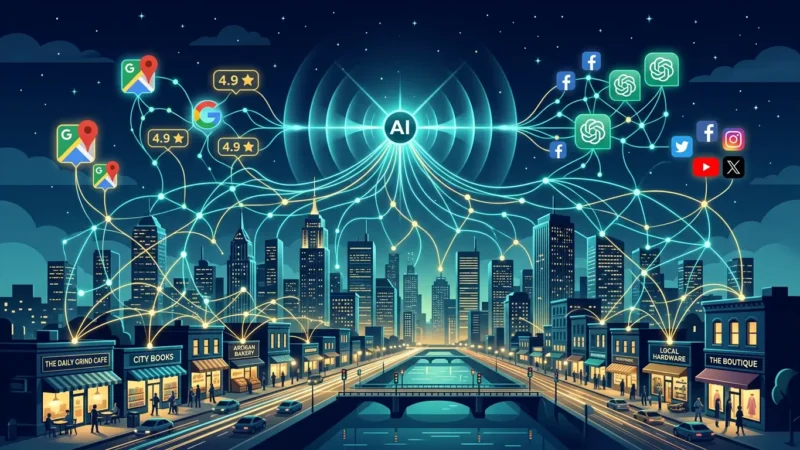
Local SEO AI visibility is now the most important growth lever for local businesses — and most owners don’t even know they’re missing it. For years, the goal of local SEO was simple: get your business to rank at the top of Google. Show up in the Map Pack. Get the clicks. Get the customers. That was the game. That was the finish line. And for a long time, it worked.
But today, that definition is dangerously outdated — especially for local businesses.
We’re now in a completely different landscape, one reshaped by AI-powered tools like ChatGPT, Perplexity AI, and Google AI Overviews (formerly SGE). These aren’t just search tools. They are decision engines — and they are fundamentally changing how nearby customers find, evaluate, and choose local businesses.
If your strategy is still only focused on Google rankings, you’re not just behind. You’re invisible in the places that matter most.
The Shift: From Clicking Links to Reading AI Answers
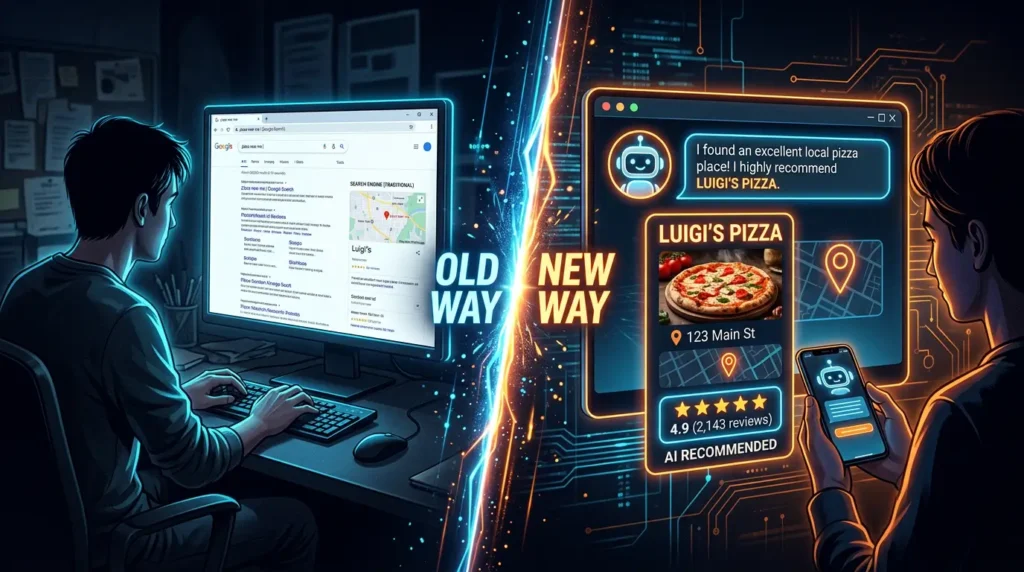
In the past, a customer would type “best dentist near me” into Google, scroll through results, read a few reviews, and click a website.
Now? Instead of scrolling through blue links, users directly ask ChatGPT, Claude, Gemini, or other AI tools questions like *”what are the best dentists near me?”* — and they’re asking AI for recommendations rather than looking through a list of links.
This creates a powerful and uncomfortable shift for local business owners:
Even if your business ranks #1 on Google Maps, you might still be completely absent from the AI conversation happening right now. A business with strong AI search visibility gets cited by name. A business without it is simply absent from that conversation — regardless of how long it has operated or how well it performs in traditional Google search.
This is the new visibility gap. And it’s growing every day.
Why AI Skips Most Local Businesses (And Why That Matters to You)
Here’s the uncomfortable truth behind the numbers: A growing share of people now turn to AI tools like ChatGPT, Claude, and Perplexity to find local businesses, asking conversational questions rather than typing keywords into Google. As this behavior becomes mainstream, a new visibility gap is opening up between businesses that are structured for AI-generated recommendations and those that are not. AI tools evaluate local listings differently from traditional search engines. Where Google looks primarily at keywords and backlinks, AI platforms look for structured geo signals: precise coordinates, nearby landmark references, neighborhood context, transit options, FAQ sections, and schema markup. Most local listing pages were built for traditional search and are simply not structured in the way AI tools need to confidently surface a recommendation.
The result? According to Gartner, traditional search engine query volume has declined an estimated 25 percent as AI-powered platforms now resolve more questions directly.
This is not a future trend. This is already happening to your customers — today.
👉 Want to know if your business is structured for AI discovery? Run a free Local AI Visibility Audit on Localaized and find out in minutes.
Where AI Actually Gets Its Local Recommendations
Understanding where AI pulls its answers is the key to unlocking your local visibility strategy Instead of returning links, AI provides answers from multiple sources like Google Business Profile, reviews on platforms like Yelp, third-party directories, business websites, and maps platforms like Apple Maps.
This means your digital presence — not just your website — is what determines whether AI recommends your business or your competitor’s. Even when AI attempts to answer a local query, it leans heavily on the same sources traditional local SEO relies on. Ask Perplexity or ChatGPT for a local service provider and it aggregates and summarizes structured data from platforms like Google, Yelp, TripAdvisor, and others.
This is critical for local business owners to understand:
Your brand is no longer defined only by your website. It’s defined by what appears — and what’s consistent — about you everywhere across the web. AI systems pull from business directories when building responses to local search queries. If your information appears consistently across multiple directories, it reinforces your credibility and improves your chances of being surfaced.
The Local SEO Ladder: From Rankings to AI Visibility
Local SEO didn’t disappear — it evolved. Think of your digital presence as a ladder, with each rung building toward full AI-era visibility:
1. 🌐 Your Website — The Foundation
Before anything else, you need a well-optimized, mobile-friendly website with clear location signals, service descriptions, and structured schema markup. This is still essential — it’s just no longer sufficient on its own.
2. 📍 Google Business Profile — Your AI-First Local Asset
Google’s AI Mode cites links to Google Business Profiles much more frequently than linking to external websites. This makes your Google Business Profile optimization one of the highest-leverage actions you can take right now. Your Google Business Profile is often the first impression local customers have of your business, and an optimized GBP results in higher visibility on Google Maps and local search results.
3. 📋 Citations & Directory Listings — The Consistency Signal
Accurate name, address, and phone number (NAP) details are the foundation of local SEO, but manually maintaining consistency across hundreds of directories is nearly impossible. AI platforms use this consistency as a trust signal when deciding which businesses to recommend. When the business name, address, phone number, or service description varies across Google Business Profile, Bing Places, Yelp, and data aggregators, AI platforms assign lower confidence scores. Inconsistency reads as unreliability.
4. ⭐ Reviews — The AI Trust Filter
AI chatbots treat reviews as a filter, not just a signal. Businesses recommended by AI average 4.1–4.3 star ratings, and the majority of consumers check two or more review sites before choosing a local provider. Large language models depend on fresh, authentic, user-generated content. Regular reviews help your business stand out in AI-powered lists.
5. 💬 Community Platforms — Where Human Conversations Fuel AI Learning
Platforms like Reddit and LinkedIn have become major AI data sources. Why? Because they contain something AI values highly: authentic human conversations and real-world experiences. Your presence and reputation on these platforms now directly influence what AI says about businesses in your category.
6. 🤖 AI Citations — Being Referenced by Machines
The next milestone is getting cited in AI-generated answers themselves. This practice of structuring local content for AI discovery has a name: Answer Engine Optimization, or AEO. It is a relatively new discipline and most businesses — including many with strong traditional SEO — have not yet addressed it.
7. 🏆 AI Answers — Appearing Inside the AI Response
The highest-value real estate in local search today is inside the AI answer itself — not below it. When AI recommends your business by name in response to a customer query, that’s the modern equivalent of a #1 Google ranking. This changes the goal from “rank number one” to “be the business the AI feels confident recommending.”
8. 🔗 The Ecosystem — Everything Working Together
At full maturity, local SEO is no longer a single channel. It’s an interconnected ecosystem: your website, your Google Business Profile, your citations, your reviews, your social presence, and your community reputation — all sending consistent, trustworthy signals to both Google and AI systems.
9. 🌟 AI Visibility — The New Endgame for Local Businesses
The ultimate goal is simple: be visible wherever AI looks when local customers are ready to decide. Winning at local SEO now means being visible everywhere customers search — traditional results and AI conversations alike.
The 4 Structural Gaps Keeping Local Businesses Invisible to AI
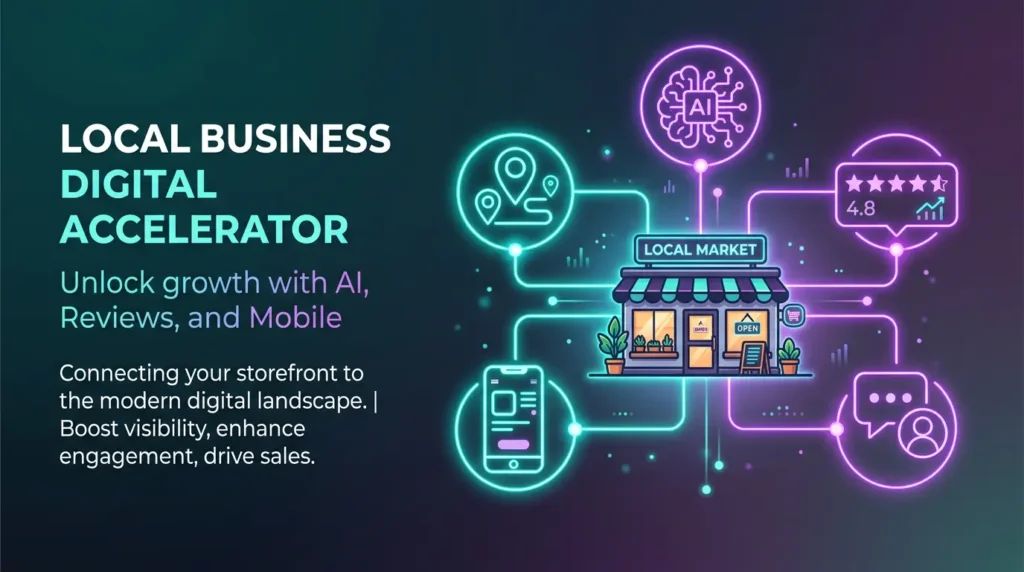
Most local businesses are missing AI recommendations not because of poor service — but because of fixable structural gaps: Most local businesses are absent from AI search recommendations due to four compounding structural gaps: missing or incomplete schema markup; inconsistent business data across directories; content written for keyword ranking rather than AI evaluation (AI systems look for question-and-answer structures, entity definitions, and citable factual statements — most local business websites were written for Google’s keyword algorithm, not for AI citation evaluation); and no confirmed entity status in knowledge graph structures.
Here’s what the fix looks like in practice:
✅ Consistent NAP data across all major directories and platforms ✅ Optimized Google Business Profile with complete categories, services, photos, and Q&A ✅ Schema markup that clearly communicates your business entity to AI systems ✅ Fresh, authentic reviews across Google, Yelp, and niche platforms ✅ FAQ-style content on your website that directly answers the questions your customers ask AI ✅ Active presence on community platforms and social channels
Localaized is built to help local businesses close all of these gaps — from citation management and GBP optimization to AI visibility tracking and local SEO audits.
What This Means for Your Local Business Right Now
If your local SEO strategy is still focused only on Google rankings and your website, you’re leaving enormous opportunity — and customers — on the table.
Modern local visibility requires a fundamental shift in thinking:
| Old Mindset | New Mindset |
|---|---|
| Rank on Google | Be present everywhere AI looks |
| Drive website traffic | Build multi-platform trust signals |
| Publish content | Participate in conversations |
| Claim one listing | Manage your entire digital ecosystem |
AI is now part of how people search, compare options, and choose where to spend money. For local businesses, that shift raises a practical question: how do you stay visible when search is no longer limited to typing keywords into a traditional engine?
The answer isn’t complicated — but it does require action. Local SEO isn’t just surviving the generative AI shift — it’s thriving. Investing in visibility across platforms, accurate business data, and review generation will keep your business discoverable no matter how the search landscape evolves.
The Real Takeaway for Local Business Owners
Local SEO is no longer about winning a position on a search results page.
It’s about owning your presence across the entire digital ecosystem — so that when a potential customer asks AI to recommend a business like yours, your name is the one that comes up.
Your business needs to show up where people talk, where communities engage, and where AI learns.
Because in this new era of local search, visibility isn’t just about being found.
It’s about being recommended, referenced, and trusted — by both humans and machines.
🚀 Ready to become visible to AI — and to the customers it influences?
Start your free Local AI Visibility Audit on Localaized →
No credit card. No complexity. Just clarity on exactly where your local presence stands — and what to do next.
Want to go deeper? Explore more from the Localaized blog:
- 📖 Local SEO Services: What You Need to Rank #1 in Your City
- 📖 How to Get More Google Reviews for Your Business (Proven Strategies That Work)
- 📖 Why My Business Is Not Showing on Google Maps (Fix It Fast)
- 📖 How to Rank in Google Maps in 2026 (Complete Guide)
Written by
Bryan Eric Tidalgo
5-year Local SEO Specialist helping US small businesses rank on Google Maps. Founder of LocalAIzed.com