
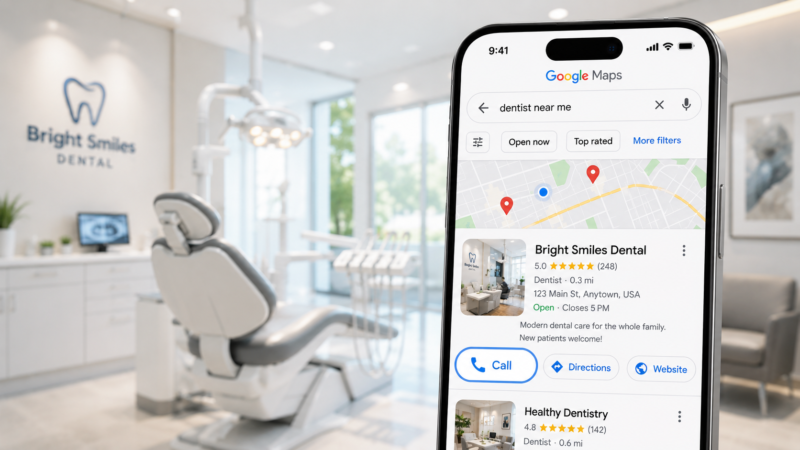
For most dental practices, the battle for new patients isn’t won in the waiting room—it’s won on a smartphone screen. When a potential patient searches for “best dentist near me” or “dental implants in [City],” Google’s algorithm decides who gets the call and who stays invisible.
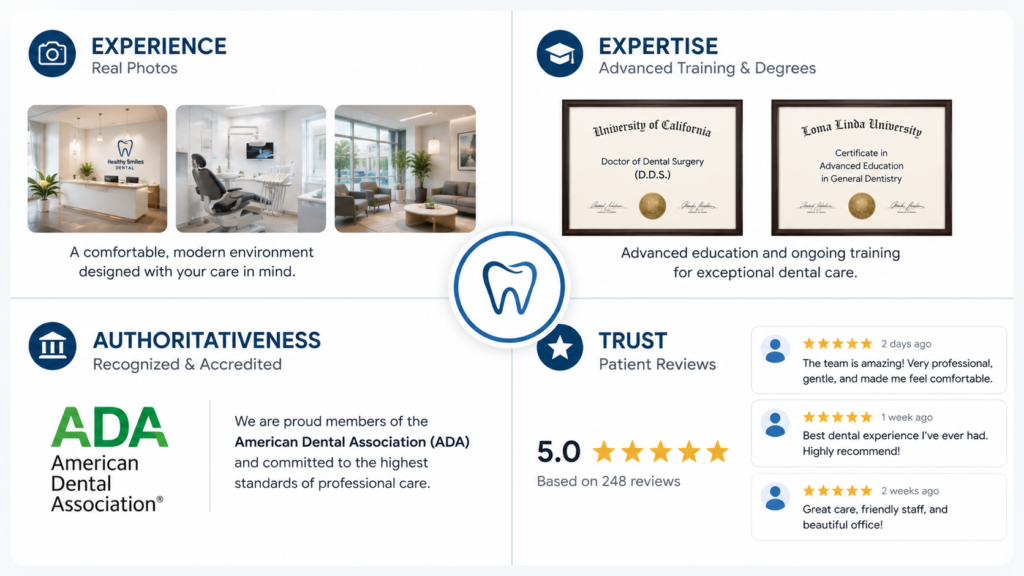
In the dental niche, Local SEO is more than just keywords; it is a battle of E-E-A-T (Experience, Expertise, Authoritativeness, and Trustworthiness). Because dentistry falls under the “Your Money Your Life” (YMYL) category, Google holds dental practices to a much higher standard of proof than it does for a local coffee shop or a retail store.
If you want to dominate the “Local Pack” and fill your calendar with high-value patients, you need a strategy that moves beyond basic listings. This guide breaks down the exact playbook for dental Local SEO in 2026.
🔍 Stop guessing how you rank against the clinic across the street. Before you change a single thing on your site, use our Free Local SEO Audit to identify your visibility gaps and see exactly where you’re leaking patients to competitors.
The Specific Challenge of the Dental Niche
Unlike emergency services like plumbing or locksmithing—where the user’s intent is “fix this right now”—dental patients are often looking for a long-term relationship. While “emergency dentist” searches exist, the majority of high-value cases (implants, veneers, orthodontics) are driven by quality, comfort, and trust.
This means your content and online presence must shift from “fast and cheap” to “expert and empathetic.” You aren’t just selling a clinical service; you are selling a healthcare experience and a relationship of trust.
Tactical Execution: The Dental SEO Playbook
1. The E-E-A-T Powerhouse (The Trust Factor)
Google’s quality raters specifically look for evidence of medical expertise. For a dentist, your “About” page is not just a biography—it is a ranking factor. To satisfy Google’s E-E-A-T requirements, your site must provide undeniable proof of expertise.
To optimize for trust, your site must include:
- Professional Credentials: Clearly list degrees, board certifications, and the universities attended. Link to these certifications where possible.
- Association Memberships: Display logos and links to the American Dental Association (ADA) or other professional bodies.
- Real Imagery: Stock photos of generic dental offices kill trust. Use high-resolution, professional photos of your actual clinic, your staff, and the lead dentist in action.
- Patient Testimonials: Integrate detailed patient stories that highlight specific outcomes (e.g., “My dental implants changed my life”) rather than generic “Great service!” reviews.
2. Treatment-Specific Landing Pages (The Authority Factor)
One of the biggest mistakes dental practices make is listing all their services on a single “Services” page. This tells Google your site is “about dentistry,” but it doesn’t tell Google you are an expert in a specific high-value treatment.
To rank for high-intent searches, create dedicated, long-form landing pages for your top services. For example:
- Dental Implants in [City]: Discuss the process, the technology used (e.g., 3D imaging), the recovery time, and the long-term benefits.
- Invisalign Treatment in [City]: Explain why Invisalign is superior to traditional braces for adults and include a detailed FAQ section about pricing and duration.
- Cosmetic Dentistry in [City]: Focus on the emotional transformation—confidence, smile makeovers, and aesthetic results.
By creating these “silo” pages, you signal to Google that you have deep topical authority in each specific area of dentistry, making you more likely to appear in the Local Pack for those specific terms.
3. Patient Experience Optimization (The Conversion Factor)
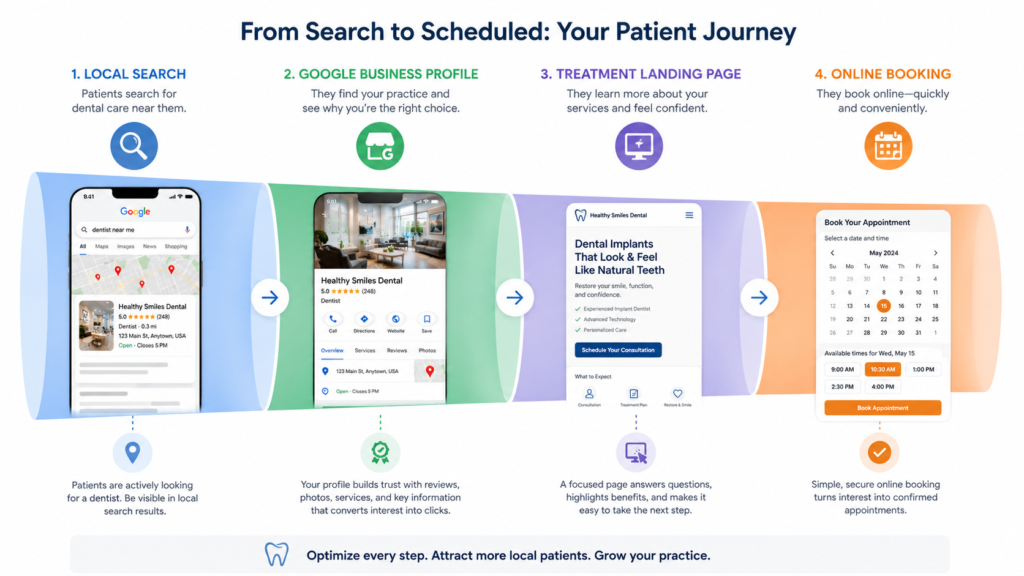
Local SEO gets the patient to your website; Conversion Rate Optimization (CRO) gets them to book the appointment. Google tracks how users interact with your site. If users land on your page and immediately bounce, your rankings will eventually drop.
To increase your conversion rate and signal quality to Google:
- Before & After Gallery: High-quality visual proof is the strongest trust signal in dentistry. Ensure these are optimized for mobile and include descriptive alt text (e.g., “Dental implant results for patient in [City]”).
- Online Booking Integration: In 2026, patients expect to book an appointment without picking up the phone. Integrate a seamless booking tool directly on your landing pages.
- Video Walkthroughs: A 30-second video showing the clinic’s atmosphere can reduce patient anxiety and increase the likelihood of a booking.
📊 Is your clinic invisible for high-value keywords? Tracking your rank is the only way to know if your strategy is working. Use our Rank Checker to monitor your position for “Dental Implants” or “Best Dentist” in your target city.
Common Dental SEO Mistakes & How to Avoid Them
| The Mistake | The Fix |
|---|---|
| Generic “Dental Services” list | Break every service into its own dedicated page with unique content and localized FAQs. |
| Ignoring the “About” page | Treat your bio as a sales page for your expertise. Include credentials, photos, and a personal philosophy on patient care. |
| No local citations | Get listed in health-specific directories (like Healthgrades or Zocdoc) in addition to standard local business lists. |
| Keyword stuffing “Best Dentist” | Focus on “Top-Rated” or “Expert” and let your reviews do the talking. Google prioritizes authentic sentiment over repeated keywords. |
FAQ: Dental Local SEO (AEO Targeted)
Q: How do I handle negative patient reviews?
Negative reviews are inevitable. The key is the response. Respond with empathy, maintain professionalism, and invite the patient to a private channel (phone or email) to resolve the issue. Never argue publicly; future patients are judging your bedside manner based on how you handle conflict.
Q: Should I focus on “Cheap Dentist” or “Best Dentist” keywords?
Unless your business model is strictly low-cost, avoid “cheap.” High-value patients (those seeking implants or cosmetic work) prioritize quality, trust, and outcomes over the lowest price. Focus your content on “Top-Rated,” “Expert,” and “Quality Care.”
Q: Do I need a blog for my dental practice?
Yes. A blog allows you to answer the “long-tail” questions patients ask before they book. Articles like “How to prepare for a root canal” or “The difference between veneers and bonding” build trust and keep users on your site longer, which boosts your overall authority.
Q: How long does it take to see results from dental Local SEO?
Typically, you will see initial movement in 3 to 6 months. Because the dental niche is highly competitive and regulated, building the necessary E-E-A-T takes time. Consistency in gathering reviews and updating content is the fastest way to accelerate this timeline.
Ready to Dominate Your Local Market?
Local SEO is not a one-time setup; it is a continuous process of building trust with both Google and your patients.
Your Action Plan:
- Audit Your Visibility: Use our Free Local SEO Audit to see where you are leaking patients to your competitors.
- Track Your Rankings: Use the Localaized Rank Checker to monitor your position for high-value keywords like “Dental Implants [City].”
- Automate Your Reviews: Make it effortless for happy patients to leave 5-star feedback with our Review Link Generator.
About Localaized: Localaized specializes in helping local service providers bridge the gap between their expertise and their online visibility. By combining AI-driven insights with proven SEO fundamentals, we help businesses grow their local footprint without the overhead of traditional agencies. Visit localaized.com to learn more.
Written by
Bryan Eric Tidalgo
5-year Local SEO Specialist helping US small businesses rank on Google Maps. Founder of LocalAIzed.com