
You searched for a coffee shop near you, and within seconds, Google showed you a list complete with addresses, ratings, and photos. Ever wonder why certain businesses appear at the top of those results?
That is the power of Local SEO in action.
In short, Local SEO is the practice of optimizing your online presence so customers in your area can find you easily. Whether you run a plumbing company, a dental practice, or a restaurant, showing up in those “near me” searches can mean the difference between an empty calendar and a fully-booked one.
This guide covers exactly what Local SEO is, how it works, and how to start getting results. No jargon. No fluff. Just actionable strategies that work for any local business owner.
Let us break it down.
What Is Local SEO Exactly?
Local SEO (Search Engine Optimization) is a strategy that helps businesses promote their products and services to local customers when they search for solutions “near them.” Unlike traditional SEO, which focuses on ranking nationally or globally, hyper-targeting the searcher’s geographic location is the main target.
For example, a search for “plumber in Austin” or “best dentist near me” activates local SEO results. Google uses the searcher’s location to show the most relevant local businesses.
Local SEO works across several platforms and surfaces:
- Google Search Results — The local pack (3-pack), map results, and knowledge panels
- Google Maps — Business listings with pins, reviews, and directions
- Voice Search — Answers from smart speakers and assistants
- Apple Maps & Bing Places — Alternative directories with their own visibility benefits
If your business depends on foot traffic or serves customers in a specific geographic area, Local SEO is not optional. It is essential.
Why Is Local SEO Important in 2026?
The numbers tell the story clearly. According to Google, 46% of all Google searches have local intent. That means nearly half of Google users are trying to find a nearby product, service, or business at any given time.
| Statistic | Source |
|---|---|
| 46% of Google searches have local intent | |
| 88% of consumers who search for a local business call within 24 hours | BrightLocal |
| 78% of local mobile searches lead to an offline purchase within 24 hours | Safari Digital |
| 28% of “near me” searches result in a purchase |
Local SEO is not just about visibility. It is about revenue.
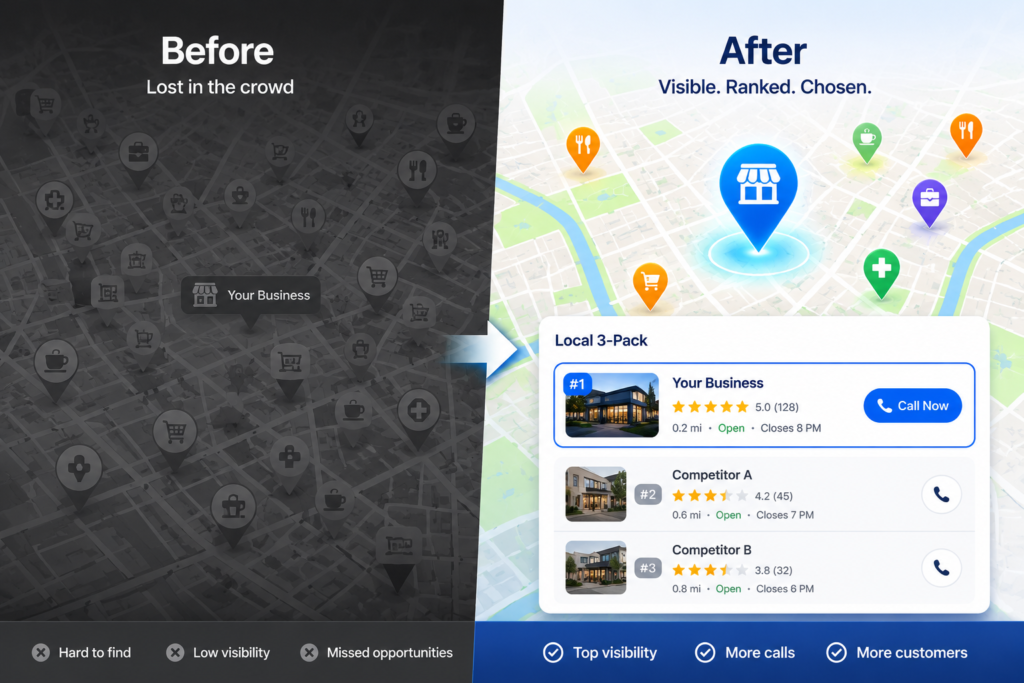
Businesses that invest in local search optimization consistently outperform those that do not. A strong local presence means more calls, more visits, and ultimately, more conversions.
How Does Local SEO Work?
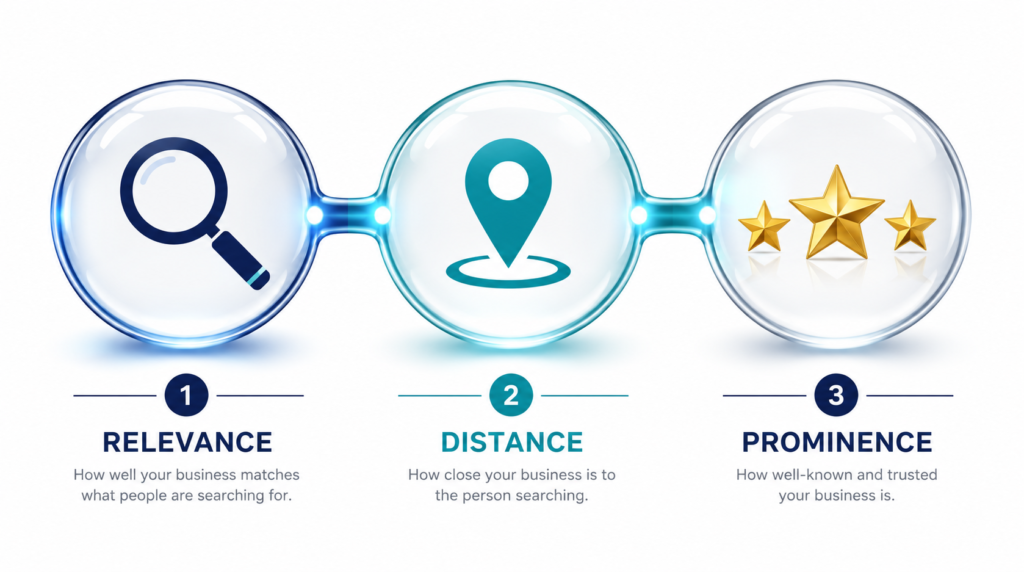
Three key factors determine your visibility in local search: relevance, distance, and prominence.
Relevance
Google wants to match the user’s search query with the most relevant business. If someone searches for “emergency plumber,” Google will compare the query against your business description, categories, services, and website content to determine how well you match.
Distance
As you may have guessed, proximity matters. A searcher in downtown Chicago will not see a plumber based at the other end of the state. Google uses your Google Business Profile (GBP) address and the “near me” intent in the query to factor in location.
Prominence
Prominence measures how well-known and trusted your business is. It takes into account the quantity and quality of your online reviews, backlinks from local directories, citations, and overall online presence.
Google uses all three factors together to decide which businesses appear highest in search. Your job is to optimize all three.
The Core Elements of Local SEO
Now that you understand the “why,” let us cover the “what.” There are several components you need to get right if you want to rank locally.
1. Google Business Profile (GBP) Optimization
Your Google Business Profile is arguably the single most important asset in your local SEO strategy. Without a fully optimized GBP, your chances of ranking are slim regardless of everything else you do.
Here is a checklist:
- Claim and verify your listing
- Use your exact business name (no keyword stuffing)
- Select primary and secondary categories accurately
- Add your complete address and service area
- Include your phone number and website URL
- Write a keyword-rich business description (up to 750 characters)
- Add all applicable attributes (wheelchair accessible, women-owned, etc.)
- Upload high-quality photos regularly (inside, outside, team, products)
- Enable messaging and respond within 24 hours
- Post updates weekly via GBP Posts
If you have not optimized your Google Business Profile yet, start there. It is free and provides immediate visibility on Google Maps.
2. On-Page SEO for Local
Your website needs to signal to Google that you are a local business. Here are the essential on-page elements:
- Title tags with location — “Plumbing Services in Austin | [Your Business Name]”
- Local schema markup — Structured data that tells Google your business name, address, and phone number (NAP)
- Dedicated service area pages — Individual pages for each city or neighborhood you serve
- Embedded Google Maps — On your contact page
- Location-specific content — Blog posts, testimonials, and case studies tied to your local area
These on-page signals help search engines understand where you operate and what you offer.
3. Local Citations and NAP Consistency
A citation is any online mention of your business name, address, and phone number. Common sources include:
- Yelp
- Yellow Pages
- Better Business Bureau
- Industry-specific directories
- Local chamber of commerce
The key is consistency. Your NAP (Name, Address, Phone) must be identical everywhere. Even small variations—like “St.” versus “Street”—can confuse search engines and hurt your rankings.
4. Online Reviews
Reviews are a ranking factor and a trust signal. Responding to reviews, both positive and negative, shows you care about customers and signals to Google that you are an active, engaged business.
- Aim for at least 4.5 stars on average
- Respond to every review within 24 hours
- Encourage happy customers to leave reviews naturally
- Never buy or fake reviews
5. Local Link Building
Backlinks from local websites, blogs, news outlets, and organizations build authority. Strategies include:
- Sponsoring local events or charities
- Getting featured in local press
- Guest posting on local blogs
- Partnering with complementary local businesses
Pro Tip: Not sure where you stand? Get a free Local SEO Audit from Localaized to see exactly what you are missing and what to fix first.
Local SEO vs. National SEO: What is the Difference?
A common question we hear is: “How is Local SEO different from regular SEO?” The answer comes down to geography.
| Factor | Local SEO | National SEO |
|---|---|---|
| Target Audience | Customers within a specific city/region | Global or country-wide audience |
| Keyword Strategy | Location-based (“plumber in Austin”) | Broad terms (“plumbing tips”) |
| Google Business Profile | Essential | Not required |
| NAP Consistency | Critical | Less important |
| Reviews | Major ranking factor | Minor factor |
| Competition | Lower (local competitors only) | Higher (compete nationally) |
| Results Timeline | 1-3 months | 6-12 months |
Both strategies can work together. If you have a local business but sell nationally, you need elements of both.
How to Do a Local SEO Audit
Before you start optimizing, you need to know where you stand. A Local SEO audit evaluates your current local presence and identifies gaps you need to address.
Here is a quick framework you can follow:
- Step 1: Google your business name and primary service + city. Note your position in the results.
- Step 2: Check if your Google Business Profile is verified and complete. Use our free Rank Checker to see how your keywords rank in your target area.
- Step 3: Search for your NAP across the top 10 business directories. Look for inconsistencies.
- Step 4: Review your website for local signals—title tags, schema, location pages, and mobile-friendliness.
- Step 5: Count how many Google reviews you have and check your average rating.
- Step 6: Look at what your top 3 local competitors are doing differently.
For a comprehensive, automated audit, try the Localaized Free Local SEO Audit tool. It analyzes your Google Business Profile, website, citations, and reviews, then gives you a prioritized action plan.
Common Local SEO Mistakes to Avoid
Even well-intentioned businesses make errors that hurt their local rankings. Avoid these at all costs:
- Keyword stuffing your business name — Google penalizes names like “Austin Plumbing | Best Plumber Austin.” Use your real business name only.
- Ignoring negative reviews — Unanswered negative reviews damage both rankings and customer trust.
- Inconsistent NAP data — Every directory must show the exact same name, address, and phone number.
- Skipping photos on GBP — Businesses with 10+ photos get 520% more calls than those without.
- Choosing the wrong primary category — Your primary category should match your core service, not a secondary one.
- Neglecting website mobile optimization — 76% of people who search for something nearby visit a business within one day. They are doing it on mobile.
- Not posting on Google Business Profile — Regular posts (weekly) boost engagement and signal freshness.
The Future of Local SEO in 2026 and Beyond
Local SEO is evolving rapidly. Here are the trends shaping its future:
AI-Powered Search: Google’s AI Overviews (formerly SGE) are changing how local results appear. Businesses with strong E-E-A-T (Experience, Expertise, Authoritativeness, Trustworthiness) signals will have an advantage.
Voice Search Growth: More than 50% of smartphone users engage with voice search daily. Optimizing for conversational queries (“Who is the best plumber near me?”) will become increasingly important.
Hyper-Personalization: Google is getting better at showing personalized results based on user behavior, past searches, and location history. Consistency across all platforms matters more than ever.
Visual Content: Photos, videos, and virtual tours on Google Business Profile are becoming ranking signals. Businesses that invest in visual content will stand out.
Zero-Click Searches: More searches end without a user clicking through to a website. This means your Google Business Profile must deliver all the information a customer needs without them ever visiting your site.
Local SEO FAQ
How long does it take to see results from Local SEO?
Most businesses see initial improvements within 1 to 3 months, with significant results appearing around the 4 to 6 month mark. Factors like competition in your area, the current state of your Google Business Profile, and consistency of effort all impact the timeline.
Is Local SEO free?
Claiming and optimizing your Google Business Profile is free. However, a comprehensive Local SEO strategy often involves investing in website optimization, review management, and ongoing content creation. There are also free tools, like our Review Link Generator, that help you generate direct links for customers to leave Google reviews.
Can I do Local SEO myself?
Absolutely. Many local business owners manage their own Local SEO successfully. Start with GBP optimization, gather reviews consistently, and create location-specific content. If you find it time-consuming or competitive markets make it difficult, hiring an agency may be worth considering.
What is the most important ranking factor for Local SEO?
The most impactful factors are: Google Business Profile optimization, review quantity/quality, NAP consistency, and on-page relevance. There is no single magic bullet—success comes from optimizing all of these elements together.
Does social media affect Local SEO?
While social media is not a direct ranking factor, it supports Local SEO indirectly. Social platforms increase brand visibility, drive traffic, and can generate local backlinks. A strong social presence amplifies your overall digital footprint.
What happens if my Google Business Profile gets suspended?
A GBP suspension means your listing disappears from Google Maps and local search. You can appeal through Google. The key is to avoid suspensions entirely by following Google’s guidelines—use your real business name, avoid fake reviews, and keep your information accurate.
Get Started with Local SEO Today
Local SEO is not a one-time task. It is an ongoing commitment that delivers compounding returns for your business. The sooner you start, the faster you will see results.
Your action plan:
- Audit your current presence — Visit Localaized’s Free Local SEO Audit to get a detailed report on your local SEO health.
- Claim and optimize your GBP — Follow the checklist above and fill out every section completely.
- Check your keyword rankings — Use the Localaized Rank Checker to track your position for the keywords that matter most.
- Generate more reviews — Use the Review Link Generator to make it easy for customers to leave Google reviews.
- Stay consistent — Post on your GBP weekly, respond to reviews daily, and update your website with fresh local content monthly.
The businesses that dominate local search in 2026 are taking action right now. Do not wait. Start optimizing today.
About Localaized: Localaized provides free, powerful tools to help local businesses improve their online visibility. From Local SEO Audits to Rank Checkers and Review Link Generators, our tools make it easy to grow your local presence without expensive agencies. Visit localaized.com to get started.
Written by
Bryan Eric Tidalgo
5-year Local SEO Specialist helping US small businesses rank on Google Maps. Founder of LocalAIzed.com