
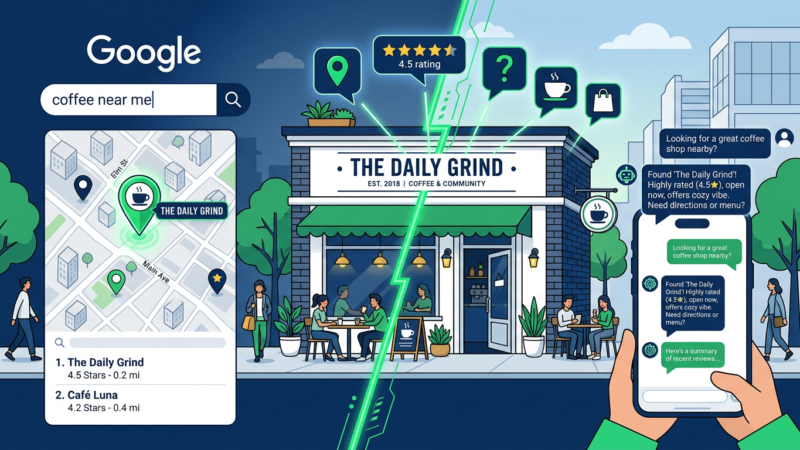
If you’ve noticed that more people are asking Siri, ChatGPT, or Google’s AI Overview for recommendations instead of clicking through search results, you’re not imagining it. Answer Engine Optimization (AEO) for local businesses is the strategy that helps your business show up in those AI-generated answers — and it’s quickly becoming just as important as traditional SEO.
This guide breaks down what AEO is, how it differs from SEO, and exactly what local businesses can do to take advantage of it.
What Is Answer Engine Optimization (AEO)?
Answer Engine Optimization (AEO) is the process of structuring your online content so that AI-powered answer engines — like Google’s AI Overviews, ChatGPT, Perplexity, Siri, and Alexa — can extract and present your information as a direct answer to a user’s question.
Instead of optimizing purely to rank on a results page, AEO focuses on becoming the answer itself.
For local businesses, this is a game-changer. When someone asks “What’s the best plumber near me?” or “Is [business name] open on Sundays?”, AEO determines whether your business gets named in the response.
Why AEO Matters for Local Businesses Right Now
Search behavior is shifting fast. According to Google’s own Search documentation, AI Overviews now appear in a significant percentage of search queries — often before any traditional organic results.
Here’s why that matters for your local business:
- Zero-click searches are rising. Many users get their answer directly from the search results page and never click through to a website.
- Voice search is local by default. Most voice queries have local intent — “near me,” “open now,” “best [service] in [city].”
- AI assistants are replacing directory browsing. People are asking ChatGPT or Perplexity for business recommendations instead of scrolling Yelp or Google Maps.
If your business isn’t optimized to answer questions directly and clearly, you’re invisible in this new search environment.
AEO vs. SEO: What’s the Difference?
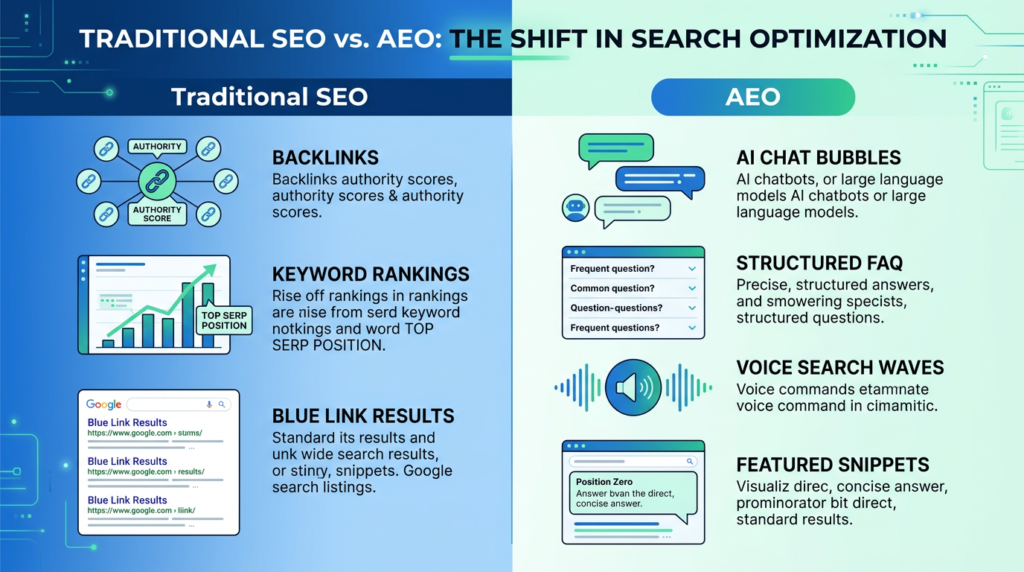
Many local business owners wonder if AEO replaces SEO. It doesn’t — but it does build on top of it. Think of AEO as the next layer of your search visibility strategy.
| Factor | Traditional SEO | Answer Engine Optimization (AEO) |
|---|---|---|
| Goal | Rank on page 1 of Google | Become the direct answer AI surfaces |
| Format | Keyword-rich pages | Question-and-answer structured content |
| Search type | Text-based queries | Conversational and voice queries |
| Result type | Blue links, rankings | AI Overviews, voice responses, snippets |
| User behavior | Click through to website | Get answer without clicking |
| Key signals | Backlinks, authority, keywords | Schema markup, clarity, authority, FAQs |
| Local relevance | Local keywords, citations | Structured local data, NAP consistency |
Both strategies work together. Strong local SEO creates the foundation. AEO makes sure AI engines know exactly what your business offers, where you are, and who you serve.
Want to check how your local SEO foundation looks right now? Try our free Local SEO Audit Tool on localaized.com
How Answer Engines Work (In Plain English)
When someone types or speaks a question, AI answer engines don’t just retrieve a web page — they extract meaning and generate a response. They pull from multiple signals:
- Structured data (schema markup) — code on your website that tells search engines exactly what your business does, where it’s located, and what questions it answers.
- Clear, direct content — well-written answers to common customer questions, placed prominently on your website.
- Authority and trust signals — consistent business information across the web (Google Business Profile, citations, reviews).
- Content format — FAQs, how-to guides, and definitions are highly favored by AI engines because they’re easy to extract and repurpose as answers.
Understanding these signals is the first step. The next step is optimizing for them — which is exactly what the rest of this guide covers.
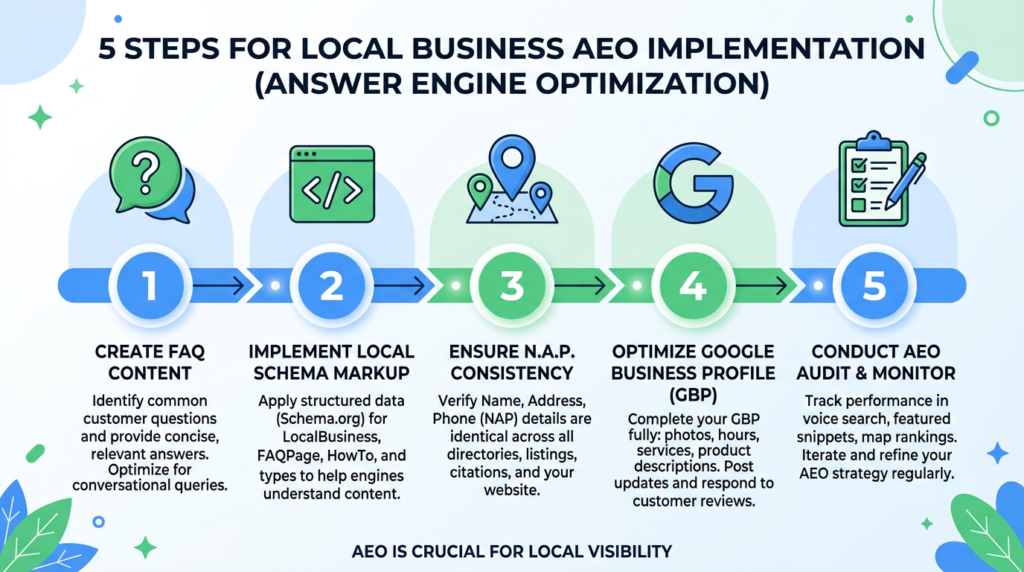
5 AEO Strategies Local Businesses Can Start Using Today
1. Write Direct Answers to Customer Questions
The most powerful AEO move is also the simplest: answer common questions clearly and immediately on your website.
Start your answer in the first 40–60 words of any section. Don’t bury the response in long paragraphs. AI engines scan for the most direct, concise answer available — make sure that’s yours.
Example questions to answer on your site:
- What services do you offer?
- What areas do you serve?
- What are your business hours?
- How much does [your service] cost?
- How do I book an appointment?
2. Add an FAQ Section to Every Key Page
FAQ sections are gold for AEO. They’re formatted exactly the way AI engines love — a clear question followed by a concise answer.
Add FAQ sections to your:
- Homepage
- Service pages
- Google Business Profile (using the Q&A feature)
- Blog posts (like this one)
Each answer should be 40–80 words, written in plain language, and relevant to local intent where possible (e.g., “Do you serve customers in [City Name]?”).
You can explore how to structure your local content effectively with our free local SEO content resources at localaized.com
3. Implement Local Business Schema Markup
Schema markup is code (in JSON-LD format) that you add to your website to give search engines structured, machine-readable information about your business. For AEO, this is non-negotiable.
The most important schema types for local businesses include:
- LocalBusiness schema — name, address, phone, hours, services
- FAQPage schema — marks up your FAQ content for AI engines
- Review schema — highlights your star ratings
- Service schema — describes specific services you offer
According to Schema.org’s LocalBusiness documentation, proper markup significantly improves how your information is interpreted and surfaced by AI-powered engines.
4. Keep Your NAP Consistent Everywhere
NAP stands for Name, Address, and Phone Number. For AEO, consistency matters even more than it does for traditional SEO — because AI engines cross-reference your business data across multiple sources before trusting it.
If your business name is slightly different on Yelp vs. your website vs. Google, that inconsistency creates doubt. AI engines default to the most trusted, consistent source.
Audit your citations regularly and fix any discrepancies. Tools like BrightLocal’s Citation Tracker can help identify where your NAP appears and whether it’s consistent.
5. Optimize Your Google Business Profile for Questions
Your Google Business Profile (GBP) is one of the primary sources AI engines use when answering local queries. Make sure it’s fully optimized:
- Fill in every field — categories, services, description, hours, attributes
- Add Q&A entries — proactively add and answer common questions in the Q&A section
- Post regularly — Google Posts signal an active, authoritative local presence
- Respond to reviews — review responses are crawled and can appear in AI-generated summaries
Learn more about GBP optimization in Google’s official Business Profile Help documentation.
What Types of Content Perform Best for AEO?
Not all content is equally useful for answer engines. Here’s a quick breakdown of what works:
| Content Type | AEO Value | Why It Works |
|---|---|---|
| FAQ pages | Very High | Direct Q&A format AI can extract easily |
| How-to guides | High | Step-by-step structure matches voice queries |
| Comparison posts | High | Clear tables help AI summarize differences |
| Service pages with schema | High | Structured data makes services machine-readable |
| Long-form blog posts | Medium | Useful if structured with headers and direct answers |
| Generic homepage copy | Low | Too vague for AI to extract specific answers |
| Product/service listings (no schema) | Low | Unstructured data is hard for AI to interpret |
AEO for Local Businesses: A Quick-Start Checklist
Use this checklist to audit your current AEO readiness:
- My website has a dedicated FAQ section on key pages
- I’ve implemented LocalBusiness schema markup
- My NAP is consistent across all directories and citations
- My Google Business Profile is 100% complete
- I’ve added Q&A entries to my Google Business Profile
- My service pages answer common customer questions directly
- I’ve added FAQPage schema to my FAQ content
- My content uses plain, conversational language (Grade 7–9 level)
- I have at least one blog post that answers a key local question
Not sure where your biggest gaps are? Run a free local SEO check with our tools at localaized.com
Is AEO Only for Big Businesses?
Absolutely not — in fact, AEO can be a significant leveler for small local businesses. Here’s why:
Large brands dominate traditional SEO through domain authority and backlink profiles. But AEO rewards clarity and structure, not size. A well-structured FAQ page on a small plumbing company’s website can outperform a national competitor if it answers the question more directly.
For local businesses especially, AEO is an opportunity to punch above your weight class by being the clearest, most organized, most complete answer available for local queries in your area.
FAQ: Answer Engine Optimization for Local Businesses
What is the difference between AEO and SEO?
SEO focuses on ranking your website on search engine results pages through keywords, backlinks, and authority. AEO focuses on structuring your content so AI-powered answer engines can extract and present it as a direct answer to a user’s question — often without any click required.
Does AEO replace local SEO?
No. AEO builds on top of local SEO. You still need strong local SEO foundations — consistent citations, Google Business Profile optimization, local keywords — but AEO adds the next layer by making your content machine-readable and question-focused.
How do I know if my business is showing up in AI answers?
Test it manually by asking ChatGPT, Perplexity, Google’s AI Overview, or Siri questions related to your business category and location (e.g., “Best electrician in [your city]”). Also monitor your Google Search Console for featured snippet impressions and AI Overview appearances. You can learn more about tracking your local visibility using the free tools available on localaized.com
What’s the fastest AEO win for a local business?
Adding a well-structured FAQ section to your homepage and service pages — with FAQPage schema markup — is the fastest, highest-impact AEO improvement most local businesses can make. It takes a few hours and can immediately improve your chances of appearing in AI-generated answers.
Do I need technical skills to implement AEO?
Not necessarily. Many website platforms (WordPress, Squarespace, Wix) have plugins or built-in tools that help you add schema markup without coding. For more advanced implementations, a local SEO specialist or web developer familiar with structured data can help.
Final Thoughts: AEO Is the Future of Local Search Visibility
The way people find local businesses is changing. Search is becoming more conversational, more AI-driven, and increasingly dominated by direct answers rather than blue links. Answer Engine Optimization for local businesses is how you stay visible in this new landscape.
The good news: you don’t need a massive budget or a technical team to get started. You need clear content, structured data, consistent business information, and a commitment to actually answering the questions your customers are asking.
Start with your FAQ section, implement LocalBusiness schema, and make sure your Google Business Profile is working as hard as it can for you.
Ready to strengthen your local search presence? Localaized.com offers free local SEO tools built specifically for local business owners and marketers. Whether you’re auditing your citations, checking your on-page SEO, or building a stronger local content strategy — we’ve got the tools to help you get found.
Explore Free Local SEO Tools at localaized.com
Written by
Bryan Eric Tidalgo
5-year Local SEO Specialist helping US small businesses rank on Google Maps. Founder of LocalAIzed.com